.svg)

Mature Clinical Labeling Models and Language Excellence
Reduce rework and approval latency to enable faster, scalable, and more predictable study start-up.


Case Study: Multilingual Retail Marketing
New AI Content Creation Solutions for a Sports and Apparel Giant
- RESOURCES





Myth #1
The Best Engine or LLM Will Drive Translation Quality
Truth: Translation excellence depends on much more than the engine powering your workflow.
Myth #2
LLMs Will Reduce Translation Costs to Near Zero
Truth: Investment will shift from human post-editing to tech costs and asset maintenance while overall costs decrease.
Myth #3
AI Will Fit Seamlessly Into Old Operational Methods
Truth: AI success requires new workflows and operational changes.
AI translation is transforming how organizations communicate across languages by driving translation efficiency and enabling global growth. Yet, as the technology advances, so do the misconceptions about its capabilities, required investment, and operational adaptation. With so much hype (and sometimes conflicting information), it’s easy to feel unsure about how best to implement it.
Understanding the capabilities and limitations of AI translation, its investment needs, and the necessary changes to your current workflow are crucial for making confident, effective decisions. By deepening your knowledge of common misconceptions, you’ll be better equipped to secure the full potential of the technology and maximize its impact on your multilingual content.
Let’s take a closer look at the facts behind three widespread AI-related myths.
Myth #1: The Best Engine or LLM Will Drive Translation Quality
It’s tempting to believe that simply selecting the most advanced engine or Large Language Model (LLM) will lead to the highest translation quality. But that’s not the case. Translation excellence depends on much more than the engine powering your workflow. Rather than relying solely on the latest engine, it’s the orchestration of technology, processes, and human expertise that drives measurable improvement in translation quality and efficiency.
By combining machine-generated translations — using Neural Machine Translation (NMT) or Retrieval-Augmented Generation (RAG) — with advanced and agentic AI post-editing prompt chains and targeted human oversight, organizations can significantly accelerate content delivery and reduce costs, unlocking new levels of speed and scalability.
The most advanced AI solutions leverage previously translated segments from Translation Memories (TMs) and glossaries to inform the LLM, ensuring that new translations follow established style and terminology. This orchestration delivers better outcomes than merely relying on a “better” engine.
Continuous improvement is central to achieving and maintaining high translation quality. Ongoing sampling of outputs, targeted customization, and updates to reference assets (TMs, glossaries) and prompts allow organizations to refine outputs and reduce errors over time, thereby decreasing the need for costly human review.
It’s not the LLM alone, but how well translation specifications are defined, assets are managed, and the process is engineered that drives exceptional results. By focusing on these elements, organizations will fully realize the promise of agentic AI and achieve reliable, context-sensitive translations that support business objectives.

“We have to embrace the idea that we’re going to spend much more on technology, compute, and AI asset management because that’s what enables the reduction to the overall price.”
—Vincent Henderson, Lionbridge Vice President for Strategy
As AI translation becomes more prevalent, companies may expect language delivery to become almost free.
But that belief is wishful thinking because engineered agentic AI workflows have very real costs. There are expenses related to technology, as well as asset maintenance and other human-managed tasks.
Unlike traditional Machine Translation (MT), where processing costs were minimal, and most expenses stemmed from human labor, today’s LLM-based solutions require greater investment in computing resources, prompt engineering, and continuous updates to Translation Memories (TMs) and glossaries, as shown in Figure 1.
Investing in these areas is precisely what enables companies to reduce overall translation costs, with savings growing faster over time as ongoing improvements lead to higher quality and less need for extensive human review.
The crucial shift to tech investment
In modern LLM-powered translation, several key factors drive technology costs, most notably token consumption, computing resources, and the complexity of agentic AI workflows.
Every time an LLM processes content, it uses tokens, which directly impact computing costs. These costs increase as translation projects become more complex, involving multiple agents performing specialized tasks behind the scenes, such as summarization, context analysis, semantic tagging, and quality assessment.
Unlike traditional MT, where technology costs were minimal, Lionbridge has established workflows that coordinate many specialized agents, each designed to handle a specific aspect of translation or compliance with style guides and terminology. This method requires more tokens and processing power, which raises technology costs; however, the use of specialized agents improves output accuracy and yields greater overall cost savings.
While it may seem counterintuitive, increased technology spending enables greater automation and long-term savings.
By investing in tokens and computing for these advanced workflows, companies reduce the need for human review and post-editing, accelerating cost reduction and quality improvement with each cycle. The more sophisticated the workflows, the more computing and tokens are required, but these investments are what unlock scalable, high-quality multilingual delivery for global organizations. To learn how LLMs can take on post-editing tasks while maintaining expected quality, visit our AI Post-Editing landing page.
As AI technology evolves, Lionbridge continually innovates and refines our workflows to optimize token consumption and ensure costs remain sustainable. Through ongoing process improvements and careful monitoring of new tools and services, we help customers realize the benefits of AI translation while managing emerging cost factors.
People power: An indispensable investment
Even as LLMs take on more tasks once done by humans, the value of human expertise in translation workflows remains essential.
Success with agentic AI solutions depends on skilled professionals who define translation specifications, engineer precise prompts, provide ongoing customization, and maintain critical assets (TMs, style guides, and glossaries). These activities require dedicated management and ongoing updates, requiring a shifting investment in these resources.
Prompt engineering and asset maintenance are not “set-and-forget” tasks; they involve continuous improvement cycles. Teams may spend several days refining prompts for a specific customer, updating glossaries, and cleaning up TMs to remove duplicate or outdated segments. With each iteration, translation quality improves, and the need for extensive human review gradually decreases, accelerating both cost reduction and accuracy gains over time.
Utilizing advanced technology and the associated costs does not eliminate the need for human involvement; it shifts where expertise is applied. Human-driven management and asset care underpin the scalable, high-quality multilingual delivery that global organizations require. While automation reduces some manual work, the costs of prompt engineering, customization, and ongoing asset maintenance remain a critical factor in the overall price of translation services.
Shifting Cost Investments Over Time Due to LLM Technology
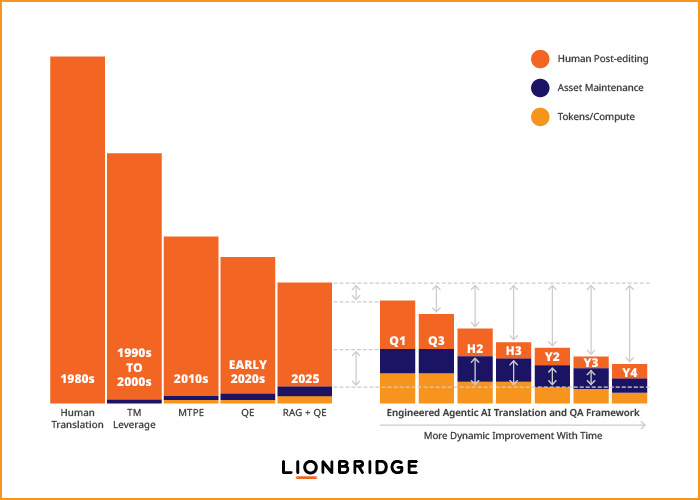
Figure 1: As technology and asset maintenance investments rise, overall translation costs decline over time
Myth #3: AI Will Fit Seamlessly Into Old Operational Methods
As AI translation technologies become more advanced, one might assume you can simply layer AI on top of existing ways of doing things, but that is not the case.
One effective approach is to consolidate global content delivery by selecting a single global content solutions provider for all your language needs. A single-vendor strategy delivers greater operational simplicity, reduced costs, and faster speed, among many other benefits. For more information about vendor consolidation, read our whitepaper, 10 Reasons To Embrace a Vendor Consolidation Strategy.
Another vital change to maximize AI benefits is to reassess the need for expensive third-party Translation Management Systems (TMSs) for multilingual content delivery; they are unnecessary. By partnering solely with Lionbridge, you can phase out legacy TMS technology and instead utilize Lionbridge Aurora AI™, our AI-first platform that orchestrates, automates, and optimizes localization workflows for exceptional efficiency. Removing an outdated TMS system from your operations will free up those resources and enable you to redirect them toward strategic initiatives that propel global growth.
Building for the future
Successfully adopting AI translation means rethinking more than just the technology. It’s about building agile, scalable language operations that support long-term business goals. From vendor consolidation to platform optimization, these operational changes empower your teams to adapt quickly to market demands and maintain a competitive edge in today’s global landscape.

Why Trust Lionbridge
Choosing a partner for global content delivery is a strategic decision that directly affects your reach and brand reputation. Lionbridge stands apart. You can be confident in every aspect of your multilingual content delivery due to our depth of experience and proven expertise.
Decades of Experience
Over the past 25+ years, Lionbridge has capitalized on evolving technologies and guided leading organizations through the complexities of translation and localization. We understand the changing needs of global businesses and have a consistent track record of delivering reliable, scalable solutions across diverse industries and markets.
Unmatched Expertise
Our team blends advanced technology with linguistic excellence. Lionbridge Aurora AI is just one example of our ongoing commitment to developing cutting-edge solutions. Supported by our unparalleled people, including top-notch linguists, we ensure your content is accurate, culturally relevant, and delivered efficiently.
With Lionbridge, you gain a trusted partner dedicated to your success, empowering you to communicate confidently and effectively with audiences worldwide.
Get in touch
Ready to elevate your multilingual content strategy with AI language solutions? Reach out today to start a conversation.


