.svg)

Mature Clinical Labeling Models and Language Excellence
Reduce rework and approval latency to enable faster, scalable, and more predictable study start-up.


Case Study: Multilingual Retail Marketing
New AI Content Creation Solutions for a Sports and Apparel Giant
- RESOURCES






Forgetting to Write Content Using Natural Language

Not Structuring Data

Not Checking Cloudflare Access Levels
AI search engine optimization isn’t on the horizon; it’s here. Millions of websites worldwide are impacted by AI search optimization — and not always for the better. If websites are only playing by the rules of global SEO because they don’t know how to optimize for AI search, they’re likely seeing lighter traffic than usual, no matter what language they’re in.
AI search engines are providing direct answers in snippets from multiple sites, negating people’s need to actually visit webpages. Often, these answers result in zero-click searches, where the person doesn’t have to visit any site to get the information they need. AI search engines are also personalizing answers for searchers, which drives people away from websites they may have visited originally, but aren’t hyper-targeted for their queries. Lastly, AI search encourages more people to perform voice searches, which reduces actual webpage visits by providing information quickly and verbally. These effects are damaging, but can be negated when a brand knows how to optimize content for AI search engines. Read our blog to learn about common multilingual mistakes in AI search optimization.
AI Search Optimization Mistake #1: Forgetting to Write Content Using Natural Language
Strong AI search content optimization in any language requires some consideration for natural language. People interact with AI conversationally, so having conversational content on your website makes it easier for AI to extract answers to user queries from your content. Then, it brings content from various sources together into a single answer to the query. AI search engines prioritize text that is written in natural language, which means it’s:
- Simple, clear, and unambiguous, so it’s easy to read
- Formatted consistently, including grammatical rules, spacing, etc.
- Providing sufficient context, which algorithms need to interpret meaning
- In a Q and A format or answering a specific question, remembering that people in different markets and who speak different languages have different questions
Generally, content written in natural language is accessible to a broad audience who speaks the language in which it’s written. This accessible quality is what AI search engines emphasize: readable, clear content for most reading levels. It’s the kind of content many users understand intuitively.
AI Search Optimization Mistake #2: Not Structuring Data
Currently, LLM bots still aren’t as sophisticated as search engines like Google. Considering this gap, optimizing content for AI search means making it easy to understand and extract. It’s helpful to use Schema markup (a type of code) to clearly define the relationships between various objects on a website, like:
- Brand(s)
- Products
- Services
- Testimonials
- More
When on-page content is well-structured and supplemented with Schema code, AI can build knowledge graphs from the information presented. These knowledge graphs help AI search engines provide more accurate, reliable, and easily understood answers. There’s also research saying knowledge graphs boost LLM performance and reduce hallucinations. If all of this isn’t convincing enough, Google and Bing’s AI teams have both publicly stated their AI search engines prefer websites that use Schema markup heavily.

AI Search Optimization Mistake #3: Not Creating Content Primed for Voice Search Optimization
As mentioned above, many AI search engines help users who want to conduct voice searches. Users interact with virtual AI services like Siri, Alexa, Google Assistant, and others. Optimizing content for voice search includes tactics like:
- Using natural, conversational tones that reflect how people typically speak. This is especially crucial if content is translated. Ensure the tone remains natural, not stiff or odd due to a poor translation.
- Creating concise, short answers to common questions. AI search engines want to read out these brief snippets to users. Consider starting questions with common words like “who, what, where, why, how,” or any other words or grammatical formats that signal a question in the target audience’s language.
- Creating FAQ pages full of short, concise answers to questions that customers may be asking.
- Implementing schema markup so AI search engines can easily understand the context of your content.
- Optimizing content for local searches, especially multilingual content. Ensure your company has a strong Google Business Profile (or multiple, depending on how many branches), with clear imagery, correct locations, a thorough list of services, and many happy customer reviews.

AI Search Optimization Mistake #4: Not Creating Personalized or Local SEO-Oriented Content
AI search engines are primarily focused on providing users with information that feels personalized, or at least like localized and culturally relevant content for them. Lionbridge offers a few AI search optimization tools and services to assist with these goals.
Lionbridge Aurora AI™: is an AI-enabled, composable content orchestration platform designed to streamline the localization process at scale to deliver content at extraordinary efficiency. Because AI search prioritizes localized content, using the platform can help boost a site’s visibility among multilingual audiences.
Lionbridge Content Remix App: This AI-powered multilingual content creation solution helps you create original content in 70+ languages. Customers looking to optimize for AI search can add in parameters to help ensure content is structured, uses a conversational tone and consistent terminology and slang, and is generally easily understood by AI search engines. Creating more content specifically for AI search optimization is highly effective.
SEO and AI Search Services: Lionbridge’s SEO and AI search experts can assist with AI search optimization from start to finish. We can audit a site, offer suggestions for new or updated content, or help implement a plan to boost traffic from AI search engines.
It’s also important to remember that AI search-ready content includes images with alt text, which are crucial for enhancing website accessibility, improving user engagement, and boosting search engine rankings.
AI Search Optimization Mistake #5: Not Checking Cloudflare Access Levels
Many of the world’s most successful websites use Cloudflare. It’s a company offering services to boost website and internet application performance, security, and reliability. Cloudflare could be covering a website’s:
- Content Delivery Network
- DDoS Protection
- Web Application Firewall
- DNS Services
- SSL/TLS Encryption
- Zero Trust Security Solutions
- Load Balancing
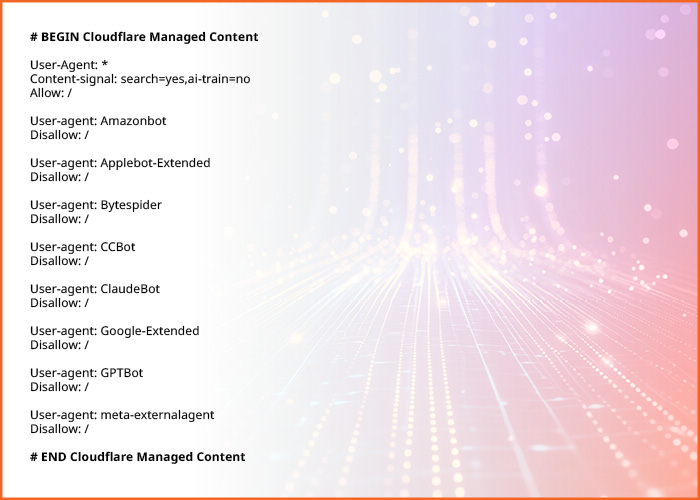
As of July 2025, Cloudflare began blocking AI by default. This approach makes many sites completely or partially invisible to AI search engines. Potential customers who use ChatGPT to search for products will see outdated information, such as prices, product availability, etc. The way to remedy this issue and remove that default setting is to:
- Review setup (robots.txt).
- Check if any AI crawlers are blocked.
- Look for the Disallow: command, particularly when followed by a/
- If there is a Disallow command associated with an AI crawler (e.g., GPTBot), remove the /.
Get in touch
Ready to boost your website’s profile with AI search engines? Lionbridge has the expertise, tools, and services to help you do it quickly. Keep your website competitive in the age of AI with a customized solution from our AI search experts. Let’s get in touch.


