.svg)

Better Patient Outcomes with Epic Language Access Integration
Learn how to improve health outcomes and ensure compliance for individuals with Limited English Proficiency (LEP) with direct language access integration to the Epic Electronic Health Record (EHR) system.


Case Study: Multilingual Retail Marketing
New AI Content Creation Solutions for a Sports and Apparel Giant
Human Expertise Blended With Powerful AI
Lionbridge Aurora AI™ is an AI-first global content platform that increases your multilingual content creation and expands your audience with culturally relevant, hyper-personalized content.
- RESOURCES





LSPs are dead. Long live global translation solution providers.
The language services industry is undergoing a profound shift. For decades, organizations relied on traditional Language Service Providers (LSPs) to bridge communication gaps, often treating translation as a transactional service managed through legacy workflows that prioritized speed and cost over business value. But AI translation is reshaping the landscape. Today’s global organizations need more than a facilitator of manual translation workflows; they need a strategic technology partner capable of building agile, scalable systems that make translation seamless and invisible.
In this new era, success depends on moving beyond outdated models and adopting a comprehensive approach to localization. Enter global translation solution providers like Lionbridge. An outgrowth of LSPs, these partners leverage agentic orchestration and human-AI collaboration to deliver a consistent brand voice, cultural adaptation, and measurable business value and ROI across content channels.
As you evaluate a language partner, ask how quickly and seamlessly they are adapting to deliver real business value.
What Characteristics Comprise a Traditional Language Service Provider?
Traditional LSPs have long been the backbone of global communication, helping organizations manage multilingual content.
LSPs offer translation as a service, relying on established workflows (including manual processes) to deliver translated content. Their approach involves coordinating translators and Quality Assurance (QA) teams to ensure accuracy and consistency across languages.
Traditional LSPs focus on facilitating translation through legacy systems, such as Translation Management Systems (TMSs), to manage multilingual content. In this model, translation involves sequential steps and human oversight at every stage. It prioritizes process management (assigning tasks, tracking deadlines, and maintaining quality controls) rather than engineering holistic solutions.
Traditional LSPs act as coordinators, bridging customers with linguistic resources and overseeing the end-to-end localization workflow. While this model has served enterprises well for many years, it is increasingly challenged by the growing complexity of content requirements and the demand for scalable, technology-driven solutions.
Why Are Traditional Language Service Providers Becoming Less Relevant in the Age of AI-Driven Localization?
As AI technologies, such as Large Language Models (LLMs), redefine what’s possible in global communication, traditional LSPs are increasingly challenged to adopt scalable, agile, technology-driven solutions. The shift toward AI localization demands a higher level of sophistication and automation that legacy workflows cannot provide.
Legacy systems can’t keep pace because their workflows were never designed to meet the demands of today’s AI-driven content, including hyper-personalization and real-time updates. While AI can scale operations, simply plugging advanced models into outdated processes only magnifies inefficiencies rather than reducing them.
LSPs that remain focused on manual coordination and incremental translation are missing the structural shift toward automation, engineered systems, and continuous translation quality. Organizations need partners who architect localization as a system.

What Defines a Global Translation Solution Provider?
A global translation solution provider differs from traditional LSPs by taking an engineered approach to localization, moving beyond traditional service models and legacy workflows. These providers are at the forefront of AI localization, setting new standards for quality and scalability.
Rather than simply facilitating translation, these providers:
- Architect comprehensive systems that unify brand voice and terminology across content ecosystems, ensuring consistent messaging at scale.
- Leverage agentic orchestration and human-AI collaboration.
- Become trusted technology partners, enabling continuous quality improvements and seamless integration into organizational processes.
With this shift, global translation solution providers ensure that AI translation is not merely a task but an invisible, integrated system that empowers organizations to connect confidently with diverse audiences worldwide and achieve their business goals, whether through global launches, multilingual marketing, or customer support.
How Does Agentic Orchestration Empower Scalable Global Content Delivery?
Unlike traditional workflows that move tasks through rigid, linear steps, orchestration adapts dynamically to evolving requirements. It spans the entire lifecycle, enabling enterprises to respond quickly to market demands and deliver content across languages, channels, and regions. This capability is essential for organizations seeking to scale their AI localization strategies for global reach.
By combining AI, human expertise, and localization governance, agentic orchestration provides operational clarity, accelerates delivery, and ensures alignment across markets. This unified approach allows enterprises to meet growing demand for real-time, multilingual content, supporting tailored experiences while maintaining control and predictability at every stage.

How Is Human Expertise Integrated into Orchestrated Workflows?
Human expertise plays a vital role in orchestrating workflows to ensure quality and authenticity.
Agentic orchestration clearly delineates tasks suited for automation and those requiring human judgment. In human-AI collaboration, AI handles routine, scalable functions such as rapid translation and initial content processing, while human experts step in for high-stakes decisions, including terminology, brand voice, compliance, and creative adaptation. This integration maximizes operational efficiency without sacrificing the nuanced understanding that global audiences require.
By mapping points of interaction between AI and humans, organizations maintain alignment, accelerate workflows, and uphold quality and intent standards. Human expertise ensures that content is not only accurate but also culturally resonant and aligned with business objectives across target markets.
What Should Organizations Look for in a Technology-Driven Translation Partner?
When selecting a technology-oriented translation partner, organizations should prioritize expertise in agentic orchestration and the ability to engineer scalable content solutions, not merely language services. The ideal partner offers unified workflows that integrate AI content creation and localization and has a proven track record of operationalizing AI-human collaboration to ensure consistent, high-quality outcomes throughout the content lifecycle.
Look for a partner that provides robust governance and maintains control over brand voice, regulatory compliance, and terminology across all channels and markets. The partner should support real-time, multilingual content experiences and offer tools for continuous quality management and predictable outcomes.
A technology-driven provider equipped for the age of AI evolves with industry advances, offering solutions that move beyond legacy, linear workflows and embrace dynamic, scalable approaches to global content delivery.
How Does Lionbridge Compare to the Others?
To learn more about our extensive AI capabilities and how we deliver comprehensive localization and content creation solutions that close the gaps left by other providers, explore our comparative analysis.
You’ll see how our competencies compare with LSPs, content and marketing agencies, Machine Translation (MT) and LLM providers, CMS and marketing tech platforms, and consulting firms, each of which offers only a subset of our capabilities.
Our competitors typically fall short in the following ways:
Select LSP competitors do not provide general-purpose agentic AI, an AI content-generation platform, AI file processing, or other advanced services, depending on the provider.
Content and marketing agencies do not provide APE, MTQE, MQM Auto LQA, or J2450 Auto LQA.
MT providers do not provide brand voice management (style guides), MQM AutoLQA, J2450 AutoLQA, general-purpose agentic AI, AI chatbots, AI content generation platforms, AI file processing, image context, image generation, or audio/video sync and dub.
LLM providers do not provide APE, MTQE, MQM AutoLQA, or J2450 AutoLQA.
CMS and marking tech platforms do not provide APE, MTQE, MQM AutoLQA, J2450 AutoLQA, or audio/video sync and dub.
Consulting firms and integrators do not provide APE, MTQE, MQM AutoLQA, or J2450 AutoLQA.
With Lionbridge, you gain access to the most complete suite of AI-powered localization and content solutions.
What Are Typical Enterprise Internal Team Capabilities?
We can help fill gaps you might be experiencing internally.
Capabilities Available Through Internal Teams
✓ = Capability Provided X = Capability NOT Provided ▲= Capability Provided, NOT Premium
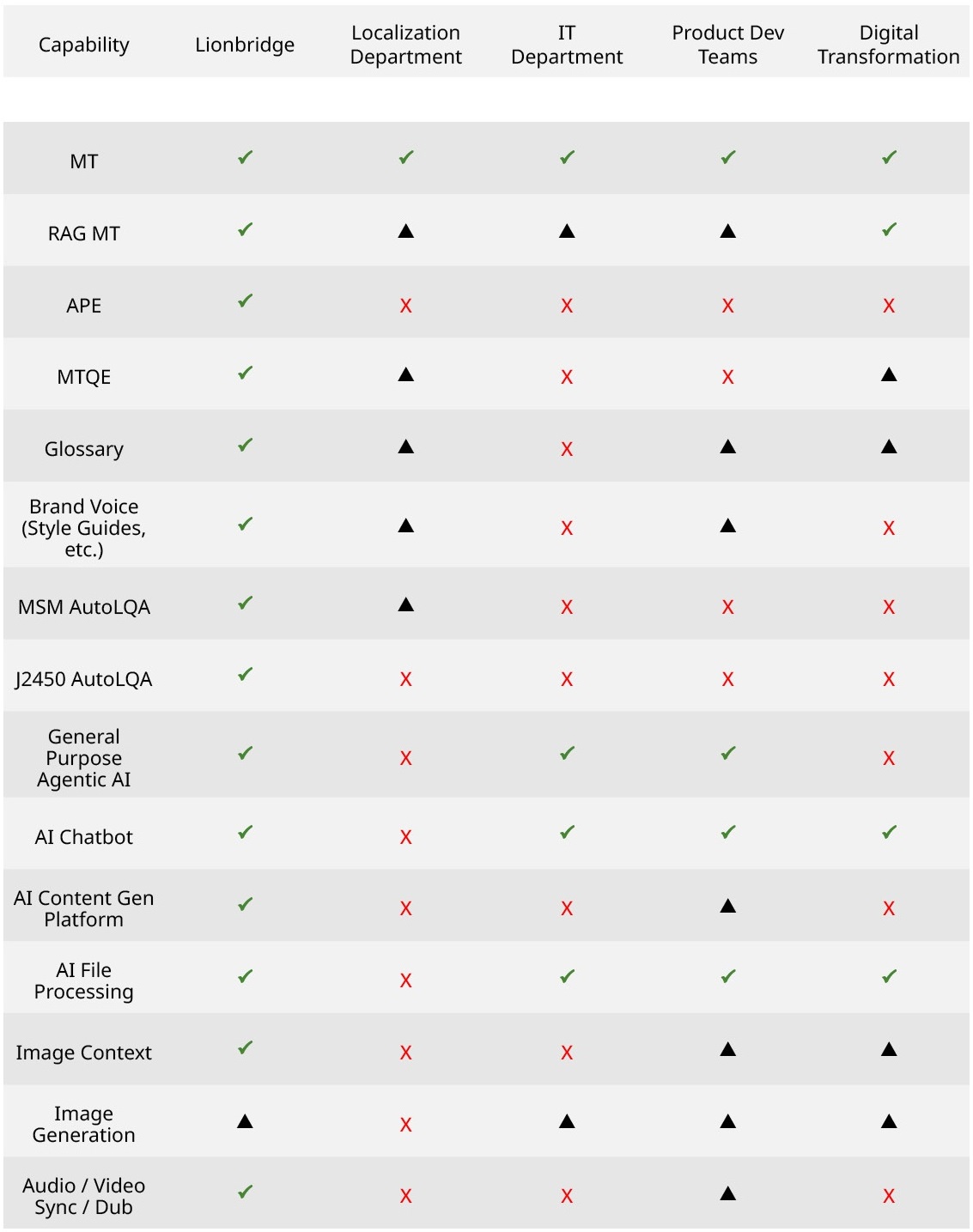
| Feature | Lionbridge | Localization department | IT Department | Product dev teams | Digital Transformation |
| MT | ✓ | ✓ | ✓ | ✓ | ✓ |
| RAG MT | ✓ | ▲ | ▲ | ▲ | ✓ |
| APE | ✓ | X | X | X | X |
| MTQE | ✓ | ▲ | X | X | ▲ |
| Glossary | ✓ | ▲ | X | ▲ | ▲ |
| Brand Voice (Style Guides, etc) | ✓ | ▲ | X | ▲ | X |
| MQM AutoLQA | ✓ | ▲ | X | X | X |
| J2450 AutoLQA | ✓ | X | X | X | X |
| General Purpose Agentic AI | ✓ | X | ✓ | ✓ | X |
| AI Chatbot | ✓ | X | ✓ | ✓ | ✓ |
| AI Content Gen Platform | ✓ | X | X | ▲ | X |
| AI File Processing | ✓ | X | ✓ | ✓ | ✓ |
| Image Context | ✓ | X | X | ▲ | ▲ |
| Image Generation | ▲ | X | ▲ | ▲ | ▲ |
| Audio / Video Sync / Dub | ✓ | X | X | ▲ | X |
Get in touch
Ready to implement advanced, AI-driven workflows for worldwide connection that enable you to achieve your business goals? Reach out today to get started.


