.svg)

Mature Clinical Labeling Models and Language Excellence
Reduce rework and approval latency to enable faster, scalable, and more predictable study start-up.


Case Study: Multilingual Retail Marketing
New AI Content Creation Solutions for a Sports and Apparel Giant
- RESOURCES





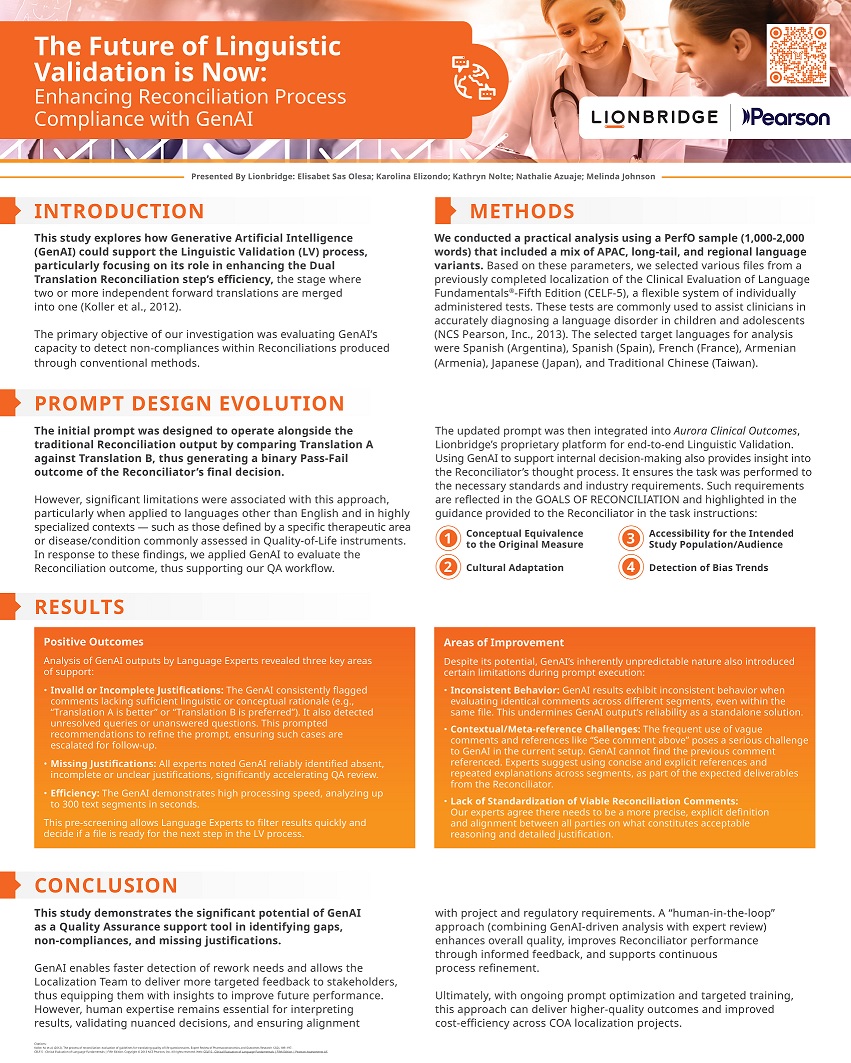
Lionbridge’s COA solutions team was proud to attend and present at the ISOQOL 2025 Conference. Our team presented two posters:
- The Future of Linguistic Validation is Now: Enhancing Reconciliation Process Compliance with GenAI
- GenAI in Action: A Study on the Efficacy of AI Comparative Review Output
Like many ISOQOL 2025 participants, Lionbridge’s Clinical Outcome Assessment (COA) services have focused heavily on AI in life sciences, particularly COA workflows. AI is even being integrated successfully into linguistic validation and eCOA migration. The conference highlighted a growing consensus: AI should serve transparency, quality, and inclusivity in addition to speed. This technology’s potential lies in augmenting qualitative, labor-intensive tasks like
- Concept Definition
- Comparative Review
- Report Generation
Notably, the 2005 ISPOR guidelines are still the standard, but a new task force is revising them to incorporate AI-supported processes. Lionbridge is joining to collaborate with this group. Read our blog to learn more about what was discussed at the ISOQOL 2025.
Key Concerns and Industry Readiness for AI in COA Solutions
Many conference participants expressed their concerns about the industry’s readiness for AI in COA solutions and workflows. These were generally:
- Privacy and data security for sensitive, patient-identifiable data
- AI-generated content and model intellectual property rights — who owns them in a regulated context?
- Ensuring responsible AI usage that doesn’t perpetuate linguistic and cultural biases
- Clear, transparent documentation of where AI is used in COA stages
- Gaps in structured frameworks for AI and COA guidelines
AI and Linguistic Validation Workflows for COA Solutions
Conference participants agreed that AI requires human oversight and strong process to ensure reliable output. The ISOQOL TCA SiG guidelines to be published in an upcoming journal article will help. Lionbridge’s approach to AI-enhanced COA solutions aligns with these guidelines.
AI for eCOA Solutions and Digital Transformation
A key topic was how AI can accelerate eCOA migration and translation quality assurance timelines. Stakeholders emphasized how AI can improve turnaround time, rather than decrease costs. There was also a distinction drawn between AI and automation, which brings many gains by itself. Sponsors were encouraged to engage regulators like the FDA and EMA early to align on AI usage in clinical trial research. Lastly, conference participants discussed ongoing efforts toward standardized AI adoption guidelines for eCOA translation and validation.
AI Can Augment the Patient Voice and Quality of Life
ISOQOL plenaries agreed that AI should predict meaningful outcomes, not just convenient ones. To this end, it can structure and interpret patient-reported data (PROs, COAs, ePROs) and help reveal patterns that may inform patient-centric endpoints. If ethically applied, AI can bridge the communication gap between patients and clinicians so we can interpret the “lived experience in clinical terms.”
Digital Health Technologies (DHTs) and AI for COA Solutions
The conference covered how DHTs are redefining how real-world, continuous, patient-centered data feed into COAs. Participants discussed how AI and Machine Learning (ML) are critical for interpreting vast datasets from DHT wearables and sensors. AI analyzes unstructured or audio-based input, turning patient narratives into actionable endpoints. This all complies with the FDA’s 2023 guidance, which stresses fit-for-purpose validation. Under such guidelines, DHT endpoints should be reliable, interpretable, and clinically meaningful.

Strategic Takeaways for More Effective COA Solutions
Conference participants took these points from the ISOQOL 2025 Conference:
- AI augments, not replaces. Its biggest strength lies in boosting human insight and efficiency.
- Transparency is non-negotiable: Stakeholders demand documentation of AI use at every stage.
- Interdisciplinary collaboration is key: linguists, clinicians, data scientists, and regulators must co-create standards.
- AI’s COA solutions’ potential lies in enhancing quality, equity, and patient-centricity.
- The future is about empowering translators or researchers with smarter tools, not replacing them.
- As the industry shapes new best practices, COA linguists and validation experts are critical in ensuring AI evolution remains ethical, explainable, and aligned with the patient voice.
Get in touch.
Need help with your clinical outcome assessment localizations? Looking for support on your clinical trial translation? Have eCOA implementation or other life sciences translation needs? Let’s get in touch to discuss.