

Better Patient Outcomes with Epic Language Access Integration
Learn how to improve health outcomes and ensure compliance for individuals with Limited English Proficiency (LEP) with direct language access integration to the Epic Electronic Health Record (EHR) system.


Case Study: Multilingual Retail Marketing
New AI Content Creation Solutions for a Sports and Apparel Giant

Human Insight, Augmented by AI
Lionbridge Aurora AI™ is our approach to AI: guided by human insight and built into every solution we deliver. Our experts apply AI to scale your multilingual content and reach new audiences with culturally relevant, hyper-personalized experiences.
- RESOURCES





This is the second part of a series on LLM ownership and execution. Read part one: So, You Want To Build Your Own LLM for Translation?
“The real challenge isn’t building an LLM-driven solution. It’s knowing when to trust the results, at production speed, and at scale.”
— Alexander Ipfelkofer, Lionbridge Director, Language AI Solutions
Kudos to you. Your organization has undergone a major AI transformation to enable AI translation with a homegrown enterprise LLM. You may be using your LLM with Retrieval-Augmented Generation (RAG) to translate into new languages instantly or incorporating it into AI post-editing (APE) workflows.
But ask yourself: How do you really know your enterprise LLM is producing multilingual output that is usable and meets your expectations? How can you fully leverage your LLM to realize AI's promise of greater content velocity, reduced operational effort, and scalable translation quality across languages? Achieving those outcomes requires more than a powerful model.
What Does It Take To Operate Your Own LLM Successfully?
To enable effective global content delivery with your enterprise LLM, you must:
Tailor localization governance to different content types and markets.
Operationalize risk-based quality controls.
Integrate human expertise when AI alone isn’t sufficient (e.g., for culturally relevant output).
Without safeguards, issues are more likely to slip into the final product, making it harder to meet local market expectations, comply with regulations, and achieve business goals. The challenge isn’t generating multilingual content; it’s ensuring that content reaching your audience is trustworthy, consistent, and fit for purpose across all the markets you serve.
Why Does Your Enterprise LLM Need a Partner To Tailor Governance for Global Content?
Every content type and market presents unique risks and requirements, and your LLM can’t navigate them alone. Governance isn’t one-size-fits-all. For example, product documentation, marketing campaigns, and regulatory communications each require different levels of oversight and review.
With a partner like Lionbridge, you can tailor LLM governance to achieve fit-for-purpose translation quality:
High-risk, customer-facing, or regulated content gets rigorous human review and validation.
Lower-risk materials benefit from streamlined automation and lighter checks.
Partnering for tailored governance ensures your LLM’s multilingual output is fast, trusted, and impactful, meets local standards, reinforces your brand, and supports your business goals wherever you operate, without unnecessary cost or delay.
Why Does Your Enterprise LLM Need a Partner To Operationalize Risk-Based Quality Controls in Your Workflow?
Risk-based quality controls ensure your LLM’s output is ready for real-world use, technically accurate, and aligned with your audience and business goals. Building these controls into your workflow requires more than automation. You need a partner that can embed quality gates at every step, calibrate review levels to match your business risk, and focus human expertise where it matters most.
When you partner with Lionbridge, your LLM’s content is scored and routed based on quality thresholds. This dynamic approach helps you catch issues early, publish with confidence, and scale quality across languages without slowing your launch cycles or overspending on reviews. As a result, your organization can deliver consistent, trusted results across markets and content types.

How Does Auto LQA Drive Quality Control?
Lionbridge’s Auto LQA (Language Quality Assessment) can provide an independent evaluation of your LLM content and detailed feedback.
As a quality gate, Auto LQA uses AI to evaluate LLM output against defined quality standards before publication, helping organizations decide whether content can be published as-is or sent to the appropriate level of human review. Depending on your risk profile, budget, and agreed-upon service level, Auto LQA can score either a representative sample of content or every segment. Sampling is more cost-efficient, while full coverage provides maximum assurance for high-risk content.
Based on Auto LQA’s scoring results, organizations can decide next steps:
If content passes the quality threshold, it can be published as-is without human review, or, depending on content type and risk profile, routed to light post-editing for a final polish. Light post-editing involves quick, targeted human corrections for content that already meets the quality threshold and needs only minor refinement.
If content fails to meet its quality threshold, it can be directed to full post-editing, where expert linguists conduct a more comprehensive review to improve accuracy, cultural relevance, and brand consistency.
Auto LQA embeds governance directly into your localization workflow by applying risk-based controls, scoring, and escalation protocols at multiple points throughout the localization process. Unlike traditional Quality Assurance (QA), which often occurs only at the final stage before publication, Auto LQA performs quality checks (evaluation and scoring) each time content changes hands, whether between automated systems or human reviewers. This means quality control isn’t just a one-time check at the end; it's an ongoing process that catches issues early and ensures content receives the right level of attention based on its needs.
This approach efficiently scales quality control and directs human expertise where it matters most. By integrating human reviews at critical points, Auto LQA helps you confidently publish multilingual content for global markets while balancing speed and quality.
What Does an Auto LQA Report Entail?
During Auto LQA, the system detects errors and generates a detailed report with quantitative and qualitative insights, providing clear explanations for human review.
Error logs include:
- Error type (capitalization, acronyms, style, and other categories)
- Error severity (minor, major, critical)
- Error explanation (what was problematic about the translation)
- Error repetition (the number of errors per category)
The system applies a severity-based penalty multiplier to each error to calculate the total impact and determine whether the content meets the quality threshold.
How Does Auto LQA Work? A Visual Overview.
Auto LQA follows these steps: bilingual input of source and target content, quality assessment, structured findings (errors and severity), and scoring, enabling the organization to decide next steps. Figure 1 shows how Auto LQA scoring can inform publication and review decisions based on quality thresholds.
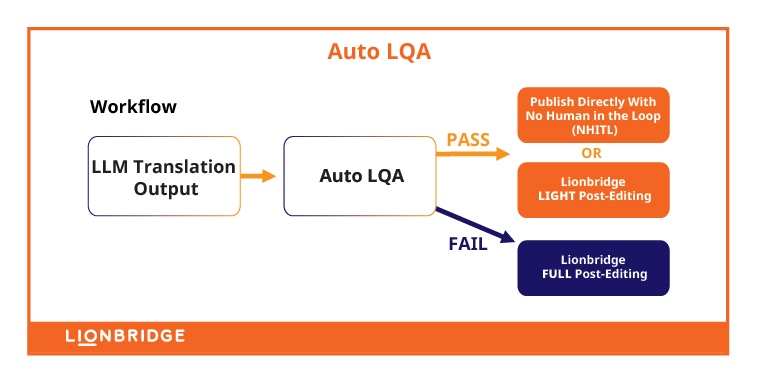 Figure 1: Content decisions organizations can make based on Auto LQA pass/fail scores.
How Can Lionbridge Enhance Your Enterprise LLM’s AI Translation Output?
As a global translation solution provider, Lionbridge brings much-needed human intelligence to help you produce publishable-quality content with less human effort and at a lower cost, using your homegrown LLM. Whether your enterprise is in the throes of global product marketing, launching a new product User Interface (UI) in multiple languages, or updating multilingual product documentation and eLearning materials, the following approaches help organizations prevent issues from reaching the final content and improve quality:
Auto LQA: Evaluates content against established quality thresholds, helping organizations determine whether critical content, such as product marketing materials, can be published as-is or must be reviewed and refined by human experts before release.
Prompt customization: Optimizes your LLM’s instructions so it faithfully applies your brand voice, terminology, and style guides across all content types, including product documentation and customer support materials.
Governance framework implementation: Establishes risk-based oversight, quality standards, and escalation protocols tailored to different content types and markets to ensure your published content is trusted and compliant.
Community-based validation: Uses a global crowd of expert reviewers to quickly validate content at scale, making it ideal for UI launches, in-context string checks, or market-specific collateral. Learn more about Aurora AI Studio™ for recruiting experienced linguists and about our AI™ data services.
AI-powered Translation Memory (TM) cleanup: Maintains and improves your TMs and language assets, preparing them for ongoing LLM use. TM cleanup reduces content errors, including those in technical documentation.
Language asset injection: Provides style guides, terminology, and TMs as reference materials to support accurate, relevant content aligned with your brand and language requirements.
By combining targeted automation, prompt engineering, human validation, and asset management, a global translation solution provider like Lionbridge can help you scale your global content, maintain brand consistency, and meet compliance requirements, so you can get the most from your LLM.

Where Can You Start?
Not sure where to begin? Explore our bundled programs, designed to meet the most common goals:
AI Output Health Check: Quickly evaluates your LLM’s translation quality by assessing a representative sample for accuracy, fluency, adequacy, and guideline adherence. It provides a baseline quality score, identifies key issues, and prioritizes areas for improvement.
Production Readiness Program: Prepares AI output for publication or customer use by reducing the risk of factual errors and hallucinations, thereby improving the customer experience. It includes output quality evaluation, language asset injection, responsible AI assessment, and post-editing.
Responsible Assessment: Enhances governance, compliance, and trust in your LLM through hallucination detection, bias and safety assessment, and governance and compliance insights.
Model Benchmarking: Compares models (and model versions) or prompts to identify the best-performing model or prompt, generates comparative scorecards, and provides optimization recommendations.
Multi-Provider Arbitration: Resolves evaluation discrepancies among providers or within evaluator pools through independent expert review, ensuring consistent quality decisions and clear, defensible quality benchmarks.
End-to-End AI Lifecycle Program: Provides consistent quality across the lifecycle, from design to release, and continuous, measurable improvement through a single accountable partner.
Get in touch
Ready to maximize your LLM investment with a partner that offers industry-leading human expertise, a diverse community of language and Subject Matter Experts (SMEs), and innovative management of your localization solution? Reach out today, and we’ll help you get started.


