.svg)

Better Patient Outcomes with Epic Language Access Integration
Learn how to improve health outcomes and ensure compliance for individuals with Limited English Proficiency (LEP) with direct language access integration to the Epic Electronic Health Record (EHR) system.


Case Study: Multilingual Retail Marketing
New AI Content Creation Solutions for a Sports and Apparel Giant

Human Expertise Blended With Powerful AI
Lionbridge Aurora AI™ is an AI-first global content platform that increases your multilingual content creation and expands your audience with culturally relevant, hyper-personalized content.
- RESOURCES





In December 2025, the European Commission published a proposal for a Regulation to simplify regulatory requirements and reduce the administrative and cost burdens of the MDR and the IVDR. The proposed regulatory compliance amendment appears less than five years after the MDR and the IVDR became fully applicable in May 2021 and May 2022, respectively.
In this blog, our medical device translation services experts question the regulators’ approach to removing the burden of document creation and medical device translations. We believe the right path forward is not simply less documentation volumes and less localization. Reducing or removing medical device information and translation will inevitably impact user safety and transparency of medical devices in the EU. The solution is rather a technology- and AI-first approach to medical device translation procedures that can significantly alleviate both administrative, resource, and cost burdens of content creation and translation. Technical integration is key to modern localization and is already transforming global industries, making content accessible, understandable, and updated across all audiences.
The Burden of Document Volumes and Medical Device Translation Procedures
While the intent of the EU regulatory reforms was to establish a robust, safe, and transparent framework for medical devices (in the EU), their implementation has been challenging. The impacts of the EUMDR/IVDR include adverse effects on device availability and competitiveness of EU manufacturers. According to a 2022 MedTech Europe survey, 50% of respondents said they were deprioritizing the EU market as their first regulatory approval option due to the MDR. Furthermore, MedTech Europe published a 2025 Report on Administrative Burden under IVDR and MDR. Among the top 3 burdens in their report are translations and updated translations of the Summary of Safety and (Clinical) Performance (SSP/SSCP), which MedTech Europe identified as a “significant administrative burden.” As a result, they recommended removing unnecessary clinical trial translations and a translations-upon-request principle, given the low likelihood of translations being consulted. On April 20, 2026, the European Association of Medical devices Notified Bodies communicated their concerns that the European Commission’s proposal for deregulating SS(C)Ps, PSURs, and recertifications would negatively impact on patient safety and transparency.

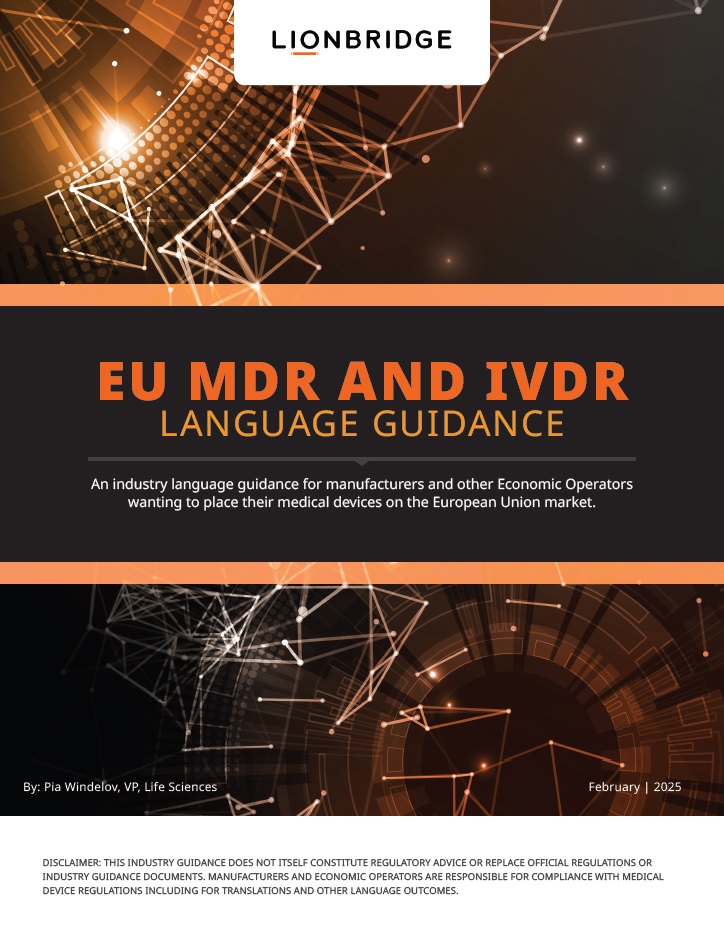
In 2025, Lionbridge published an eBook on language requirements under the MDR and IVDR. It’s arguably the most comprehensive and freely available industry guidance on MDR and IVDR language implications on medical device translation procedures. Lionbridge’s guidance on medical device translation requirements was published on MedTech Dive for medical device manufacturers and other Economic Operators. In a systematic review of all Articles of the MDR and the IVDR, as well as MDCG guidance documents, Lionbridge’s clinical trial translation services experts analyzed and compiled technical and plain language requirements. They also provided recommendations to manufacturers wanting to place their devices on the multilingual EU market. Notably, the guidance also encouraged manufacturers to adopt a centralized and risk-based AI lifecycle language strategy. This AI medical device translation approach would unlock efficiencies for medical device translation volumes, cost savings, and language consistency throughout the device lifecycle.
An AI-first Approach Over Content Reduction for Medical Device Translation Procedures
Technology-first and AI-first localization is a strategic approach to localization. All content through the product’s lifecycle lives in an integrated, agile, engineering-driven infrastructure. Integrated technologies and Large Language Models (LLMs) have shifted localization from a downstream translation-and-tools approach to a technology-enabled, AI-powered ecosystem managing the end-to-end content lifecycle. Medical device translation procedures are no longer isolated, but sit inside:
- Intelligent orchestration platforms
- Interconnected design systems
- Advanced production workflows
- Rich content and terminology libraries
- Various authoring systems (CMS, CCMS, PLM, RIM)
The language services industry is uniquely qualified to optimize language outcomes across these technologies and content systems, thereby reducing administrative burdens for medical device manufacturers. As global multidisciplinary experts across technology, AI, language, and life sciences, we touch all content streams and focus on continuous localization, where content is created, translated, updated, and governed as a living system, rather than as static documents.

Get in touch
Need assistance with your medical device documentation translation? Reach out today to discuss how we can help reduce administrative and cost burdens of regulatory translation for medical devices in the EU and make content accessible to all your product users. Or, download our EU MDR and IVDR Language Guidance here. Let’s get in touch.