.svg)

Better Patient Outcomes with Epic Language Access Integration
Learn how to improve health outcomes and ensure compliance for individuals with Limited English Proficiency (LEP) with direct language access integration to the Epic Electronic Health Record (EHR) system.


Case Study: Multilingual Retail Marketing
New AI Content Creation Solutions for a Sports and Apparel Giant

Human Expertise Blended With Powerful AI
Lionbridge Aurora AI™ is an AI-first global content platform that increases your multilingual content creation and expands your audience with culturally relevant, hyper-personalized content.
- RESOURCES






The Evolution of Procurement Models

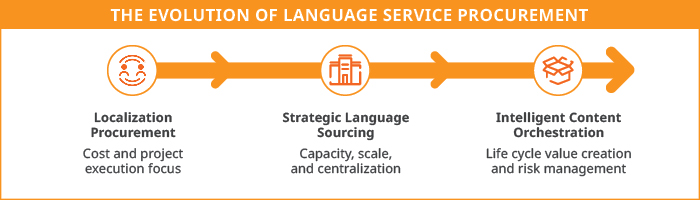
As a Commodity

As a Managed Capability

Orchestrated Content Ecosystems
Historically, life sciences language services have been treated as a commoditized downstream support activity in the context of core R&D services, such as data management, site management, and lab services. This transactional approach to language procurement is becoming obsolete. Today, traditional language service providers (LSPs) are evolving into language technology providers (LTPs) and language solution integrators (LSIs) that deliver strategic value to the life sciences industry.
In this blog, our clinical trial translation services team explores the evolution of language services. It outlines why language procurement should be viewed as a strategic, value-driven activity on par with core R&D services in life sciences product development. Technology-first global content solutions providers, like Lionbridge, can deliver both strategic and operational value to global industry leaders across the entire product content life cycle.
The Evolution of Life Sciences Language Services and Procurement Models
Life sciences language services have transformed profoundly from a primarily transactional, cost-driven function to a strategic, intelligent enabler of global growth and innovation. Cost is still a key criterion for supplier selection in the Life Sciences industry. Still, competitive differentiation is growing in the added support that language technology providers can offer in navigating complex regulatory compliance challenges, rapid technological advancement, and solving the needs of many stakeholders involved in globalization. Pharma and MedTech companies need life sciences translation services providers that offer language technologies, content infrastructure capabilities, and multidisciplinary expertise across linguistics, AI, and life sciences.

Life Sciences Language Services as a Commodity
For years, life sciences language services procurement has been managed through fragmented supplier networks. A multinational phase 3 clinical trial could involve several translation agencies supporting the localization of clinical trial materials before submission of the clinical trial application. Clinical trial translations were often managed locally by affiliates or local trial or site management teams. Often, language supplier selection was also driven by local trial budgets, supplier preferences, or insights into country-specific language expectations from Independent Ethics Committees and Institutional Review Boards.
Localization during these years was largely reactive. Language service requests were triggered late in document or product development cycles and executed on a project-by-project basis. Additionally, the clinical trial application process in Europe was decentralized under the (now repealed) Clinical Trials Directive (CTD). The CTD required local submission procedures to National Competent Authorities in each EU Member State. It therefore warranted local procurement practices for clinical trial translations.
While this decentralized procurement model offered a degree of flexibility and local autonomy, it frequently resulted in inconsistent quality, duplicated efforts, and limited scalability across global clinical programs. For Pharma and MedTech companies, such a fragmented or transactional approach to language procurement translated into weak process standardization. The lack of centralization and governance constrained long-term efficiency and increased compliance risk and inconsistencies across global markets.

Life Sciences Language Services as a Managed Capability
With increasing globalization, technological progress, and regulatory harmonization, Pharma and MedTech enterprises have started treating life sciences language services as a managed capability (not a commoditized transaction). Regulatory harmonization began in the 1990s and into the mid-2000s with Good Clinical Practice standards. However, language procurement centralization didn’t materialize until clinical programs further globalized and translation technologies became enterprise solutions that unlock scale economies for procurement.
The transactional approach to life sciences language services still exists under indirect procurement models or CRO outsourcing regimes. However, Lionbridge has seen many customers recently consolidate the language category under global strategic procurement functions. These companies are reducing their supplier bases and shifting language spend from indirect to direct models, in some cases going from as many as 50 providers to 10. Other Lionbridge customers have unbundled language services from full-service CRO Agreements to obtain cost transparency and scalable language operations under a direct strategic partnership model.
The centralization of Clinical Trial Applications under the EU Clinical Trial Regulation and the centralized Clinical Trial Information System (applicable from 2022) has changed the procurement ecosystem around clinical trial translations. Strict regulatory timelines, increasing content volumes, modern protocol designs, and accelerating clinical trial execution necessitate centrally managed and agile language services.
In a harmonized, accelerating, and globally expanding clinical trials environment, traditional LSPs are evolving into strategic partners who offer:
- Domain expertise
- Standardized processes
- Technology-enabled workflows
- Translation management systems
- Terminology databases
This shift delivers measurable improvements in quality, scalability, and operational efficiency. This new procurement approach enables Pharma and MedTech companies to better align localization with product development and commercialization timelines.
Orchestrated Content Ecosystems for Life Sciences Language Services
With AI and Large Language Models (LLMs), the current environment around language services and language procurement is disruptive and fundamentally transformational. Global LSPs are transitioning into global content solutions providers, and language translations are becoming embedded within an end-to-end, technology-enabled content lifecycle. Content creation and translation will no longer exist as disconnected, standalone activities. Instead, they’ll be part of a connected ecosystem of content. LLMs can be trained to create draft protocols, patient information, and results summaries across languages.
At the most advanced end of this evolution, the concept of the source file diminishes. It’s replaced by direct generation of multilingual target files in local languages, based on advanced prompt specifications with built-in regulatory requirements. Source content or trial master files are still core for regulatory approvals and compliance documentation in life sciences. Still, simultaneous multilingual content creation already exists in the retail industry, e.g., with the Lionbridge Content Remix App. The benefits are reduced content creation cycle times and cost savings.
The Strategic Imperative for a New Procurement Model
The evolutionary stages we’ve presented overlap and are not strictly sequential. Procurement maturity varies across Pharma and MedTech enterprises. One conclusion is certain, however: life sciences language services are no longer just about translations. It’s about these activities and qualities across the entire product content life cycle:
- Content analysis
- Creation
- Translation
- Summation
- Intelligence
Language service providers used to meet project specifications. Now, they’re becoming strategic content-excellence partners, contributing to business issue resolution and growth. To fully leverage technological innovation within the content life cycle, global procurement leaders should think strategically about content at enterprise level of product development.
Get in touch
Ready to explore how life sciences language services can help you go to market faster and achieve better patient outcomes? Wondering how to get the most ROI out of your clinical trial services? Let’s get in touch.


